

National: Universal Housing Assistance (United States)

The following post discusses the current state of Federal housing assistance in the United States, ongoing efforts to make rental assistance an entitlement available to all qualifying households in the era of COVID-19, and why Housing Choice Vouchers is not the right model for a universal housing assistance program.

Many proponents of social justice believe in a Right to Housing. This right entitles all people to be housed in healthy, safe, and desirable accommodations regardless of a person’s ability to afford to pay for those accommodations. Any gap between what households can afford and the cost of minimum standard housing is seen as a need.

Supply, Demand, and the Market
When there is demand for a product or service, there are a few ways that demand can be satisfied. Demands for goods and services can be provided in a marketplace, through private charity, by a publicly-funded government service, or through other means.

When a person is willing to pay for a good or service, but does not have the capacity to pay someone else to provide that good or service for a mutually agreed upon price, that demand cannot be satisfied through the marketplace. If there is an ability to pay for a product or service, but no one willing or able to provide for that demand, a market has yet to emerge to satisfy the opportunity. Only when there is a convergence between one’s willingness and capacity to pay someone else for a product or service AND an ability to provide that good or service for an agreeable price can a marketplace begin to emerge to satisfy demand through competition among providers and consumers. Absent this convergence, either charity, the State, or another means is required to subsidize, or provide, that product or service.

In the 19th century, rising wages, employment stability, and disposable income for a growing middle class due to industrialization provided an opportunity for robust markets to emerge for consumer goods, professional services, various kinds of insurance, and many other products and services. Rising incomes also provided opportunities for private transit services and utilities. Over the course of the 20th century, social activists increasingly saw these goods and services as a need and access to them as a right. In the 21st century, access to high-speed internet is seen as a necessary provision, particularly amid stay-at-home orders during the Covid-19 global public health epidemic.

Fulfilling the Right to Housing
Ultimately, in the view of social justice advocates, the State (through its tax payers) is responsible for ensuring the adequate provision of desirable housing to all people. More specifically, the onus for generating revenue for State redistribution ought to fall upon those citizens who’ve accumulated wealth.

In practice, income and consumption is taxed more often than wealth.

When the State is unable to generate sufficient revenue to house all people, there are two options. First, the available revenue can be used to provide as many people as possible with the means to attain desirable housing, while advocating to raise additional revenue for everyone else. Second, the available revenue can be distributed among all those who lack adequate housing, while advocating to raise additional revenue to cover the full gap between incomes and private market housing costs.

Today in the United States, the former describes the status of funding for housing. Limited government revenue is redistributed to a fraction of the number of qualified applicants, while social justice proponents advocate for ways to generate additional funding. For decades, housing programs, like rental and downpayment assistance, have left most qualified people without assistance most of the time.

A Housing Assistance Entitlement Program
Recent scholarship, news coverage, and media attention on the issue of residential evictions across the United States has sparked greater interest in and support of turning rental assistance, specifically Federal Housing Choice Vouchers (HCV), into a universal entitlement program available to all qualifying households.

Housing advocates sometimes point to the Supplemental Nutrition Assistance Program (SNAP) as a model for HCV to emulate. SNAP provides participants with a debit card that is regularly-replenished with funds for the duration of the entitlement. The payment card can be used for food purchases at qualifying grocery stores. The program helps to supplement recipients’ incomes by covering the gap between what households can comfortably afford to pay for food and the estimated cost of groceries that provide a nutritious diet.

Funding Universal Housing Choice Vouchers
Some proponents of making Federal rental assistance into an entitlement program, point to the Home Mortgage Interest Deduction program as a potential funding source. Every year millions of American homeowners deduct the interest on their monthly mortgage payments from their taxable income. Repealing this deduction for households earning more than $100,000 a year could generate an additional $52 billion in Federal income tax revenue from existing homeowners with mortgages. That revenue could cover the cost of making the Housing Choice Vouchers program a universal entitlement.
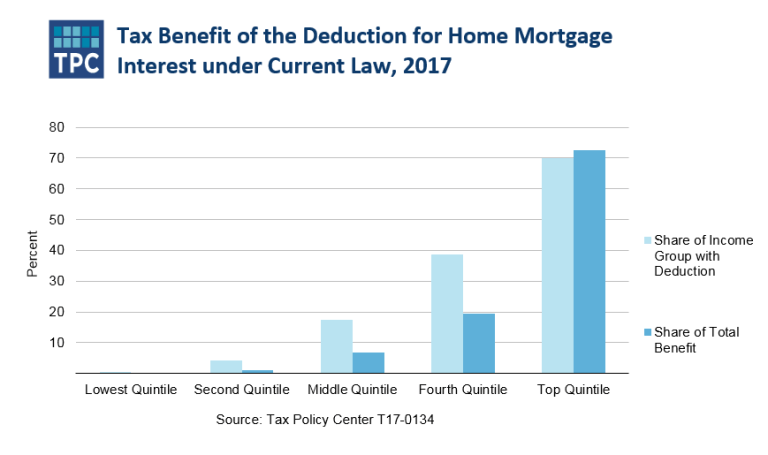
Due to its popularity among homeowners, removing the mortgage interest deduction for so many families would be politically difficult. Moreover, doing so would be perceived as a tax increase on the salaries of workers in order to subsidize low-income rental property investors. Equally difficult politically, but perhaps a more ethical way to pay for universal housing assistance, would be either: a tax on household wealth, or to repeal the IRS Building Depreciation policy, which allows passive rental income to be sheltered from taxation. In any case, there are several deeper issues with current thinking about the Right to Housing, a universal housing assistance entitlement program, and using SNAP as a model.

Conclusion
If housing is a human right then people are entitled to require a responsible party, usually a government agency, to house them. In the United States, housing must meet minimum standards of habitability and safety. Any gap between the cost of providing minimum standard housing and the amount someone can afford to pay for that housing becomes a need that the State is responsible for covering for all people. Since the cost of providing housing that meets minimum standards is very high, and the earnings of low-income households are comparatively meager, covering that price gap for millions of American households is expensive. In the near-term, funding the Right to Housing is untenable economically and politically.

Furthermore, if people are entitled to anything, it is not a Right to Housing, but a Right to Habitat. Guaranteeing the human habitat to all is far more feasible, just, and desirable than trying futilely to guarantee a right to housing. Households are responsible for housing themselves. Neither the State nor developers are responsible for housing others. When public policy inhibits households from housing themselves, reform must focus on empowering current and future residents to house themselves. Instead, reform efforts often mistakenly focus on attracting professional real estate investors and developers.

Even if universal housing assistance through rental vouchers and downpayment assistance were economically and politically feasible, which they aren’t, such an entitlement program would produce undesirable outcomes. That low-income rental property investors are in such unanimous support of housing assistance ought to offer a clue as to the primary beneficiaries of rental and downpayment assistance programs (hint: not tenants).

Increasing the provision of rental vouchers and downpayment assistance would: 1) fuel acquisition by property investors, 2) primarily benefit realtors, sellers, and lenders, and 3) increase housing values and prices for homebuyers.

Lastly, the Supplemental Nutrition Assistance Program is indeed an appropriate model for a universal housing entitlement program. However, the Housing Choice Vouchers program is not an appropriate housing program to universalize as an entitlement. If SNAP provided adequate funding for recipients to purchase professionally prepared and served meals from restaurants throughout the day for each member of the household, then it would be the equivalent of a universal rental assistance entitlement program.

A nutrition assistance program built on that model would be prohibitively expensive to fund due to its over-reliance on professional commercial-grade food preparation and service costs. Instead, SNAP supports food purchases at grocery stores to enable home cooking. Therefore, a housing entitlement program for all qualifying households would not be Housing Choice Vouchers, but a Supplemental Housing Assistance Program.

If you want to learn more about the Right to Habitat or how a Supplemental Housing Assistance Program could work, explore these services offered by DEMOCRATIZE DEVELOPMENT.
Local: Yale Law School ‘Preventing Displacement’ Report (New Haven)

Several major American cities and States across the country have recently enacted land use reforms to encourage higher density, mixed-use, and walkable development. A clinic at the Yale Law School, working in collaboration with the City of New Haven, recommends amending the City’s zoning regulations in accordance with popular planning trends. The following article, however, suggests that more low-cost housing units could be created if existing provisions in the zoning ordinance were promoted to residential property owners.

In May 2020, the Jerome N. Frank Legal Services Organization at Yale Law School released the report Preventing Displacement: Three Approaches to Protect New Haven Residents. Home to the world-renowned research institution of higher education with a multi-billion dollar endowment, New Haven is a diverse Connecticut city of 130,000 residents in a metro area of nearly a million people. The Report identifies a housing crisis in New Haven that is largely characterized by a lack of affordability for many of the city’s low- and moderate-income residents, which may lead to short- and long-term displacement. The Report offers three approaches for preventing residential displacement.

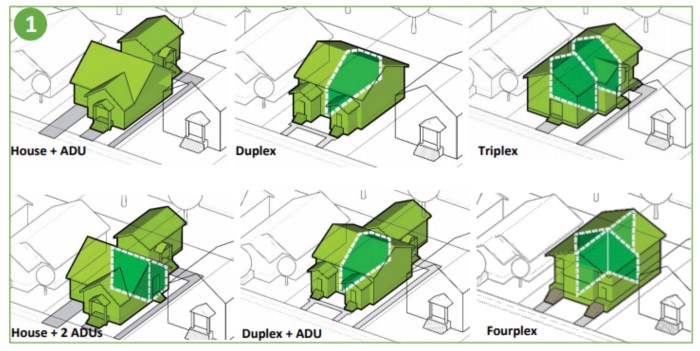
First, it proposes a series of tenant protections targeted at reducing evictions and increasing landlord accountability. Second, it considers strategies for new development that can provide affordable alternatives for residents: single room occupancy, accessory dwelling units, and rezoning single-family areas to allow for multi-family buildings. Third, it covers strategies for foreclosure prevention, including changes to tax liens and the initiation of foreclosure mitigation strategies. Each section then provides policy proposals, some which can be implemented at the municipal level and some which require action at the state level.

“Preventing Displacement” p. 4


DEMOCRATIZE DEVELOPMENT applauds the efforts of the student researchers and the law school professors that worked on this project. Their efforts attempt to address some of the housing issues currently impacting the small New England city in which their academic institution is located. There is much to unpack in the authors’ description of the housing crisis in New Haven, the three approaches offered in response to that crisis, and the specific policies proposed in the report.

For the sake of brevity, however, the following commentary will be limited to concerns with the second section of the Report, Development, which deals with reforming the City’s zoning regulations and encouraging small-scale development like Single Room Occupancy (SRO), Accessory Dwelling Units (ADU), and multifamily conversions of single family residences.

‘Preventing Displacement’ or Encouraging Dispossession?
All quotes are from pages 15-25 in the Preventing Displacement Report.

The first, and best, way to allow more construction in New Haven’s wealthier enclaves would be to abolish single-family RS-1 and RS-2 districts. Cities across the country have up-zoned such properties within their municipal limits.

Since the Great Recession, institutional investors, acting through real estate professionals, have spent millions – often in cash – to acquire thousands of properties and amass a vast portfolio of rental properties in the City of New Haven. Upzoning residential neighborhoods may increase the value of properties and encourage large-scale investment firms to further acquire residential properties many of which are currently owned by their occupants or hyper-local landlords.

Multiple Dwelling Units: A Type of Inexpensive Housing?

While New Haven has taken laudable steps to welcome all forms of residential construction, this section will primarily focus on zoning and financing strategies to promote small-scale, inexpensive development.

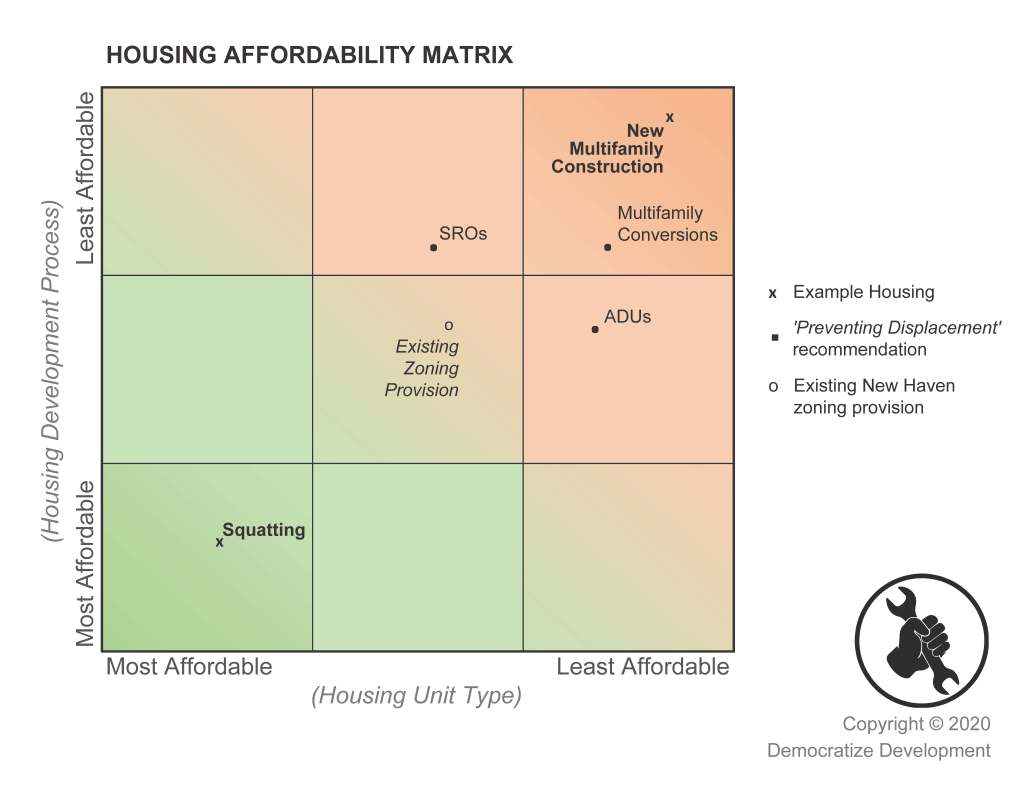
On the one hand, the Yale Law School Report does promote some housing strategies and unit types that tend to cost less than new market rate development. These strategies and types include small-scale development interventions, homeowner participation, and the conversion of existing spaces to new uses. Housing that is only slightly less expensive than new market rate development, however, is not affordable to low-income households. Much greater cost savings is required. On the other hand, by promoting dwelling units, multifamily construction, and professional real estate development, the authors of the Preventing Displacement Report are actually advocating for some of the most expensive housing strategies.

The construction of single- and two-family dwellings are regulated under the International Residential Code (IRC). Multifamily construction must adhere to the International Building Code. The IBC sets far more stringent standards and often requires hiring an architect. Multifamily buildings must have fire separation between units and common spaces, fire suppression systems like sprinklers, two means of egress, handicap-accessible units, and elevators in multistory buildings.

Even two-family houses require a minimum of 200 amp electrical service, whereas 100 amps is sufficient for a single-family dwelling. All dwelling units must contain full kitchens and bathrooms. Detached back yard dwellings require extending existing sewer, water, and electric service from the main house to the new unit, or establishing new connections to the street. The significant costs and physical changes associated with creating new dwelling units limits their adaptability.

The construction of additional dwelling units can be very expensive – ranging from tens to hundreds of thousands of dollars per unit.

Restrictive Zoning or Restrictive Information?

In many American cities including New Haven, restrictive zoning limits the potential for new and creative housing development, including SROs, ADUs, or the conversion of single-family homes to accommodate multiple households. We offer several regulatory land use policy changes to mitigate this problem.

The Report is correct that New Haven’s zoning regulations limitat residential density by placing a cap on how many units may be built. DEMOCRATIZE DEVELOPMENT, however, believes that a lack of information about existing zoning provisions, rather than restrictive regulations, may be a larger issue in the city.

New Haven should permit its existing SRO zoning as-of-right across the City or across a larger swath of downtown.

Unbeknownst to the authors, the City of New Haven already allows SROs citywide. These existing provisions are more restrictive than what is advocated for in the Report, but they nevertheless exist. The City might consider expanding existing provisions before undertaking the difficult political fight of allowing Rooming, Boarding, and Lodging Houses in residential districts.

The City should also reform the zoning code in its single-family neighborhoods to allow property owners to construct ADUs or convert preexisting single-family zones to allow for multi-family construction.

As difficult as it may be for the authors to believe, New Haven already allows multiple housing units on single-family residential properties in the RS-1 and RS-2 zoning districts (the City’s two single-family zones). Furthermore, many two- and three-family houses that were built prior to the City’s adoption of zoning in the 1920s exist within single-family districts.

Under New Haven’s existing regulations, residential property owners citywide are allowed to create additional housing units by right.

Interestingly, the existing zoning provisions allow for the creation of housing units that are less costly than the types of housing that would be allowed by the recommended regulations in the Report. New Haven could allow ADUs or multifamily conversions in single-family zones, but doing so only makes sense if similar goals cannot be achieved by promoting the creation of additional housing units under existing provisions.

Zoning Approvals in New Haven

New Haven should allow owners to convert their properties to multi-family lots or to construct additional units without requiring homeowners to go through the burdensome zoning board approval process.

Outside of New Haven’s single-family zones, multifamily conversions are common. For buildings of sufficient size, conversion requires only administrative zoning approval and building permitting. For buildings of insufficient size or where exterior additions like dormers are desired, the Report is absolutely correct that applicants must go through a zoning approval process, which can be burdensome, and often results in denials.

The student authors are right about some multifamily conversions, but they are incorrect about additional housing units always requiring zoning approval and building permitting. In many cases, residential property owners in New Haven are currently allowed to create additional housing units with only written approval from the enforcing officer. When interior structural changes are being made, a building permit and fee are required. Exterior alterations, like additions, require zoning review in addition to building permitting. Merely changing the use of existing rooms, however, can be accomplished at virtually no cost.

Minimum Parking Requirements

Parking minimums are a burdensome and unnecessary requirement both for families who wish to add a new unit to their homes and for developers that wish to build SROs, subsidized apartments, and even standard market-rate units.

In New Haven, additional off-street parking is only required when: 1) adding dwelling units to a property in any district or 2) when increasing the number of bedrooms to a house in the city’s single family zones. Additional housing units that are not dwelling units, however, do not require additional off-street parking spaces. In single family districts, decreasing the number of bedrooms decreases the number of required off-street parking spaces. Therefore, parking minimums are not necessarily a burden for families who wish to add a new unit to their home or developers that wish to build SROs.

The Report’s broad point that higher minimum parking requirements tend to increase housing costs is fair. DEMOCRATIZE DEVELOPMENT agrees that reviewing New Haven’s parking requirements is worthwhile. For instance, the City might consider allowing more efficient parking space arrangements in residential districts and calculating parking requirements based on dwelling units, rather then bedrooms, in single-family zones.

SROs and the Spectrum of Housing Types

When SROs are available, they can provide “the last rung on the housing ladder before homelessness,” though they still cost $450 to $750 per month in expensive cities.

Considerable variety in cost is possible with Lodging Houses depending on the location of bathrooms and presence of shared living, dining, and cooking space. On the full spectrum of housing options, SROs are on the middle rung between dwelling units at the top and less expensive types of housing at the bottom. Rental rooms, particularly those not in Lodging Houses, must play a role in addressing affordable housing issues, but they may not be a viable solution for many households, especially those with children.

Code Enforcement

Short-term rental regulation would preserve the primary use of SROs and other micro-units for New Haven residents while maintaining an Airbnb market. New Haven should adopt […] policies […] to limit the conversion of long-term housing to short term rentals.

Other than in commercial districts and licensed Lodging Houses, New Haven currently prohibits renting out bedrooms for stays fewer than seven consecutive days. DEMOCRATIZE DEVELOPMENT believes that the City of New Haven ought to figure out a way to enforce its existing regulations before adopting new ones. At the same time, New Haven’s Livable City Initiative housing code inspectors have been incorrectly issuing citations on accessory housing units. As a result, many affordable units have been decommissioned or required to be converted into dwelling units.

Supply, Demand, and Financing for ADUs

ADUs can increase a city’s housing stock and reduce income segregation by providing low-cost housing in fairly wealthy areas. While building new housing can be prohibitively expensive and perceived as risky by investors, ADUs are cheap to build and a low-risk alternative.

As stated before, dwelling units, including those built under accessory provisions, are a relatively expensive type of housing. ADUs may be lower-cost than new multifamily construction, but this housing type is often more expensive than other housing units such as SROs.

Increasing the overall supply and density of dwelling units, whether through ADUs, conversions, or new construction, may help stabilize or even lower the price of housing in high-demand communities. However, the addition of dwelling units to a former single-family property may also substantially increase the property’s value, thereby making current and future owners dependent on constant rental income to cover their own monthly mortgage payments, even if the value per dwelling unit is lower than the original value of the single-family house.

While lending products to fund ADU development are increasingly available, many property owners still lack access to appropriate financing tools in their area to fund the design and construction of ADUs. As a result, ADU construction has largely been reserved for wealthier homeowners who have access to home equity loans, personal savings, and other funding sources for home improvement work.

Development Assistance for Residential Property Owners

A zoning reform package paired with subsidies and support for homeowners would increase the amount of new housing units in single-family residential areas.

For the reason stated previously, the Yale Law School Report is correct that zoning reform alone is not likely to substantially increase the number of additional dwelling units, especially affordable units, built in single-family neighborhoods unless there are subsidies. DEMOCRATIZE DEVELOPMENT supports promoting existing zoning provisions that allow for the creation of additional housing units without requiring new amendments to land use regulations, onerous approval and permitting, additional off-street parking, or the expense of creating new dwelling units.

Conclusion
The best approach for any situation depends enormously on the intended goal. If, in the case of housing development, the goal is to increase permit revenue for cash-strapped municipalities, attract real estate investors, and permanently increase the supply of dwelling units, then ADUs, multiple dwelling conversions, and new multifamily construction may be appropriate policies to pursue. If, however, the goal is housing affordability, government programs at the Federal, State, and local level will need to subsidize development and developers through rental assistance, construction grants, and tax breaks. Or, on the other hand, a city like New Haven could promote their existing zoning provisions that already allow for highly flexible and low-cost types of housing to be built throughout the city.

Aspects of New Haven’s existing zoning regulations may actually serve as appropriate models for other communities to adopt as they attempt to address housing affordability issues and segregation. If early efforts fall short of goals, then perhaps New Haven and other communities ought to look into expanding those existing provisions or adopting new regulations for ADUs, multifamily construction, and lodging houses.

As this commentary has indicated, there are benefits to looking at national planning trends to inform local efforts, but there is also a risk. Included in that risk is a proclivity to ignore or entirely miss existing local traditions that, if rediscovered and promoted, may achieve many of the same results as well-publicized, but politically-divisive, policies being implemented in other cities.

For instance, is allowing ADUs and multifamily conversions advisable in New Haven because it is the best policy for the city? Or is it being advised because rezoning efforts in places like the City of Minneapolis and the State of Oregon have garnered considerable publicity in news media? DEMOCRATIZE DEVELOPMENT believes that local communities should first understand and work with what they already have before looking to implement whatever planning policies are currently trending.